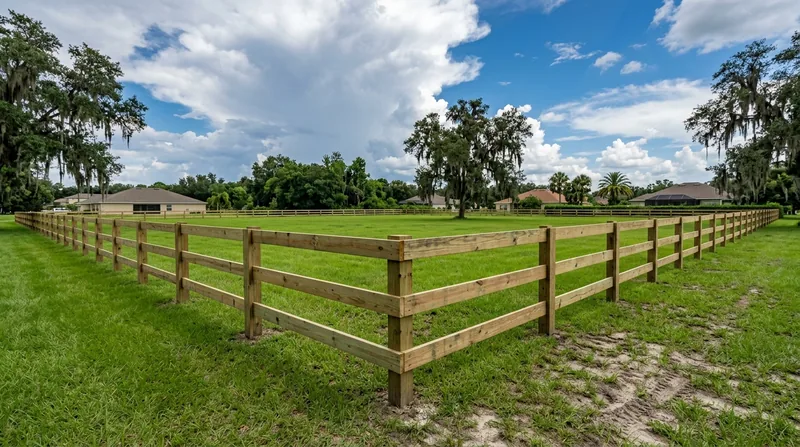




Farm fence installation in Orlando requires more than standard residential fencing know-how. Central Florida acreage sits on flat, sandy, well-drained terrain dotted with small lakes and cypress-lined retention ponds, where post-setting depth, concrete footing, and bracing against wind and moisture become critical to a fence that holds for decades. Whether you're running a property line across pasture, building a ranch fence installation for livestock, or securing equipment on acreage in Winter Park, Windermere, or Apopka, the fence must handle Florida's wet season, afternoon thunderheads, and the occasional tropical system that strips palms and tests every connection. Orlando Fence Company has installed and repaired farm and ranch fencing across Greater Orlando since 2015, and we understand the specific demands of acreage in this region.
Why Farm & Ranch Fencing Matters in Orlando Acreage
Residential fencing in Orlando's subdivisions works within sight lines and property setbacks measured in feet. Acreage fencing operates at a different scale. A pasture line runs 200 feet or more; a field gate must swing clear for a tractor or trailer; corner posts carry brace loads that would snap a standard residential post. Central Florida's sandy soil drains well in dry months, but during the summer wet season, water tables rise and post footings can shift. Wind pressure from afternoon thunderstorms and named storms tests every corner brace and gate hinge. The fence you build on acreage must survive years of weather, livestock pressure, and equipment use without sagging or pulling away from the line.
- Posts set deep in concrete footings resist heave and frost action, critical in Florida's seasonal water table swings.
- Braced corners and anti-sag bracing hold long runs straight against wind and livestock pressure.
- Proper post spacing and rail sizing prevent sagging and maintain gate clearance for equipment and trailers.
- Florida 811 utility locates are required by law before any post hole is dug, protecting buried electric, water, and gas lines.
These details separate a fence that lasts from one that fails in a single wet season or storm cycle.
Key info: Acreage in Windermere, Winter Garden, and Apopka often straddles jurisdictional lines. Orange County, Seminole County, and city ordinances each set their own setback rules, height limits, and permit requirements. Verify local rules and HOA deed restrictions before design work begins. The Orange County Planning Division and your city building department have the final word on what you can build.
How We Install Farm & Ranch Fencing: From Survey to Gate
Farm and ranch fencing starts with the property line. We work from your existing survey and install on the line you identify, establishing corner posts and running straight lines over long runs. Central Florida's flat terrain makes this work straightforward, but the sandy soil demands careful footing. We set posts deep, use concrete below the water table to prevent heave, and brace every corner to handle wind and livestock pressure. The fence type depends on your use: split rail fence installation for open pasture and visibility, no climb horse fence for equestrian properties, pipe fencing for heavy equipment containment, or barbed wire fence installation for cattle and perimeter control.
- Locate the property line using your existing survey and mark the fence run.
- Call 811 for utility locates at least 48 hours before digging (required by Florida law).
- Set corner and end posts in concrete footings below the seasonal water table.
- Install rails, stringers, or mesh between posts, maintaining proper spacing and tension.
- Brace corners with anti-sag bracing to hold the line against wind and pressure.
- Install and hang gates with hardware rated for the load and sized for equipment access.
- Test all gates for swing, clearance, and latch operation before final walkthrough.
Each step is verified on site before moving to the next, ensuring the fence runs true and every connection holds.
Local example: A 5-acre equestrian property in Windermere with a split rail perimeter, two pasture divisions, and a double-wide equipment gate. We set 24 corner and line posts in concrete, installed 1,200 linear feet of 4-rail construction, and hung a cantilever gate at the entry drive. The job took eight working days and cost $18,400. The fence runs straight, the gate swings freely, and the posts sit below the seasonal high water mark.
Farm & Ranch Fencing Methods for Orlando Acreage
| Approach | Description | Best for |
|---|---|---|
| Split Rail | Pressure-treated or cedar rails mortised into corner and line posts, typically 3 or 4 rails high. Posts set in concrete. Classic appearance, good visibility. | Pasture boundaries, equestrian properties, rural aesthetics where visibility matters. |
| No-Climb Horse Fence | Rigid welded mesh or woven wire with small openings (2x4 or 2x6 inch) mounted on posts and top rail. Prevents hooves from catching. Durable under herd pressure. | Horse pastures, equestrian boarding, any application where livestock safety and durability are paramount. |
| Pipe Fencing | Welded or bolted steel pipe (typically 2 inch or 2.5 inch diameter) on concrete footings. Powder-coated or galvanized for rust resistance. Extremely strong and long-lived. | Equipment containment, high-traffic areas, properties with heavy machinery or vehicles, maximum durability. |
| Barbed Wire | Stranded barbed wire (typically 4 or 5 strand) stretched between posts with post-mounted insulators or wire fasteners. Posts often set in concrete. Low cost, effective perimeter control. | Cattle pastures, perimeter security, large acreage where cost per linear foot is a priority. |
| Field Wire & Posts | Woven or welded wire mesh (various gauges and opening sizes) on wooden or metal posts. Flexible configuration, adaptable to terrain and use. Moderate cost and maintenance. | Mixed livestock, general pasture, areas where the fence may need future modification or repair. |
Each method is chosen for the terrain, livestock type, equipment access, and expected service life on your property.
Farm & Ranch Fencing Cost in Orlando: What to Expect
Farm and ranch fencing costs start at approximately $12 per linear foot for basic split rail or barbed wire on acreage with good access and level terrain. That figure assumes posts set in concrete, standard spacing, and no unusual site challenges. Costs rise when terrain is uneven, access is difficult, posts must be set deeper due to water table proximity, or when you choose no climb horse fence or pipe construction. A 500-foot run of split rail on level acreage in Orlando might run $6,000 to $8,000. The same distance in pipe or welded mesh, with multiple gates and corner bracing, can reach $12,000 to $15,000. Gates add $800 to $3,000 each depending on width and hardware.
Several factors move the cost up from the baseline. Sandy soil requires careful post-setting and concrete footing to prevent heave. Seasonal water table fluctuation in Central Florida means posts must sit below the high-water mark, sometimes requiring deeper holes and more concrete. If the property line crosses low spots or retention ponds, sections may need racking or stepped installation to maintain proper height and tension. Equipment access, property size, and the number of gates all affect labor time and material count. We recommend getting 2 or 3 estimates for any acreage fencing project, because site conditions vary significantly. See our pricing page for detailed breakdowns by method and size, or call us for a free on-site estimate at (689) 400-2205.
Farm & Ranch Fencing Near Me: What Orlando Homeowners Should Know Before Hiring
Hiring a contractor for acreage fencing in Orlando or surrounding areas means checking three things: insurance, local permitting rules, and experience with the specific fence type you need. First, confirm that the contractor carries full general liability and workers' compensation insurance and can provide a certificate of insurance on request. Second, understand that fence licensing in Florida is set county by county, not statewide. Orange County, Seminole County, and city ordinances each have their own rules. We hold what the local authority requires, and we recommend calling your county building department or city planning office to verify permit requirements for your property before design begins. Third, ask for references from acreage fencing jobs completed in the last 3 years, especially if you want split rail, no-climb horse fence, or pipe construction. Acreage fencing is different from residential work, and the contractor should be able to show completed examples.
Other key points: verify that 811 utility locates will be called before any digging (required by Florida law), confirm that the fence line will be run from your existing survey (we do not perform surveys or boundary determinations), and ask about warranty or service commitments if posts or gates need repair after installation. If your property is in an HOA or master-planned community like Horizon West or Lake Nona, check deed restrictions for height, material, and color before committing to a design. Many acreage properties in Greater Orlando are also subject to county or city environmental or conservation easements that may restrict fence placement or type. We work with those constraints, but they must be identified upfront. Call us at (689) 400-2205 or use our contact page to request a free estimate and discuss your specific property and needs.
Orlando Fence Company is an AFA Member Installer through the American Fence Association, and we have been serving Greater Orlando since 2015. We are fully insured and offer a certificate of insurance on request. We handle farm and ranch fencing across Orlando, Winter Park, Winter Garden, Windermere, Kissimmee, Apopka, Ocoee, and surrounding areas. If you have acreage and need a straight, durable fence that will last through Florida's weather, call us today.
Farm & Ranch Fencing in Orlando: Pricing Guide
| Service | Price | Details |
|---|---|---|
| Split Rail Fencing | Starting at $12/ft | Pressure-treated or cedar rails on concrete-set posts. Cost rises with post depth and terrain difficulty. |
| No-Climb Horse Fence | Starting at $15/ft | Welded mesh or woven wire with posts and top rail. Includes all hardware and corner bracing. |
| Pipe Fencing | Starting at $18/ft | Steel pipe welded or bolted, powder-coated or galvanized. Highest durability, maximum load capacity. |
| Barbed Wire Fencing | Starting at $8/ft | 4 or 5 strand wire on posts. Lower cost option for perimeter and cattle containment. |
| Gates & Hardware | $800-$3,000 each | Cost depends on width, material (wood, pipe, welded mesh), and hinge type (cantilever, V-track). |
| Free Estimate | No charge | On-site assessment within 24 hours. Call (689) 400-2205 or use our contact page. |
Indicative pricing, the exact cost depends on square footage, finish, and site access. Free personalized estimate within 24h at (689) 400-2205.


